Connecting Science and Industry: INERRANT Conference Highlights
The conference season 2026 has just started and INERRANT partners have already been actively engaging with the scientific and industrial community across Europe. From fundamental chemistry discussions to applied battery innovation and circular economy forums, INERRANT researchers are sharing early insights and building valuable connections. Here are some of recent highlights:
European Workshop on Pnictogen Chemistry 2026 (EWPC 2026)
At the European Workshop on Pnictogen Chemistry (EWPC 2026) in Dresden, Eugen Khitro (JMU) presented INERRANT’s work from an application-oriented perspective. While the conference largely focused on the synthesis and characterisation of different compounds and their fundamental understanding, Khitro’s contribution showcased the potential of phosphorus-based additives for lithium-ion batteries. Beyond presenting, the event provided valuable insights into phosphorus chemistry beyond battery applications, as well as inspiration for future molecular design strategies, potentially supporting the development of new additive concepts within the INERRANT project.
“I gained deeper insights into phosphorus chemistry and its applications beyond batteries. Additionally, I got some inspiration for molecular design, which can be used to test new kinds of phosphorus-based additives within our current project. Besides the scientific aspects, I really appreciated networking with other PhD students about their projects and everyday struggles. It was also great to have the opportunity to visit the beautiful city of Dresden,” reflects Khitro.
18th International Conference on Advanced Battery Power
The Advanced Battery Power conference took place in Münster from 14 to 16 April 2026, focusing on the latest research findings, technological innovations, and practical applications. INERRANT member Jens Timmermann (Fraunhofer ISC) presented the ongoing work on engineering stable interfaces of Ni-rich layered oxide materials – an essential aspect for improving battery performance and longevity.
“I’m grateful for the opportunity to present our work on engineering stable interfaces of Ni-rich layered oxides at this year's Advanced Battery Power conference in Münster. Now, I’m excited to continue advancing our understanding of the interplay between surface modification and interface stability,” highlights Timmermann.
TVIP 2026 | Týdne výzkumu a inovací pro praxi a životní prostředí
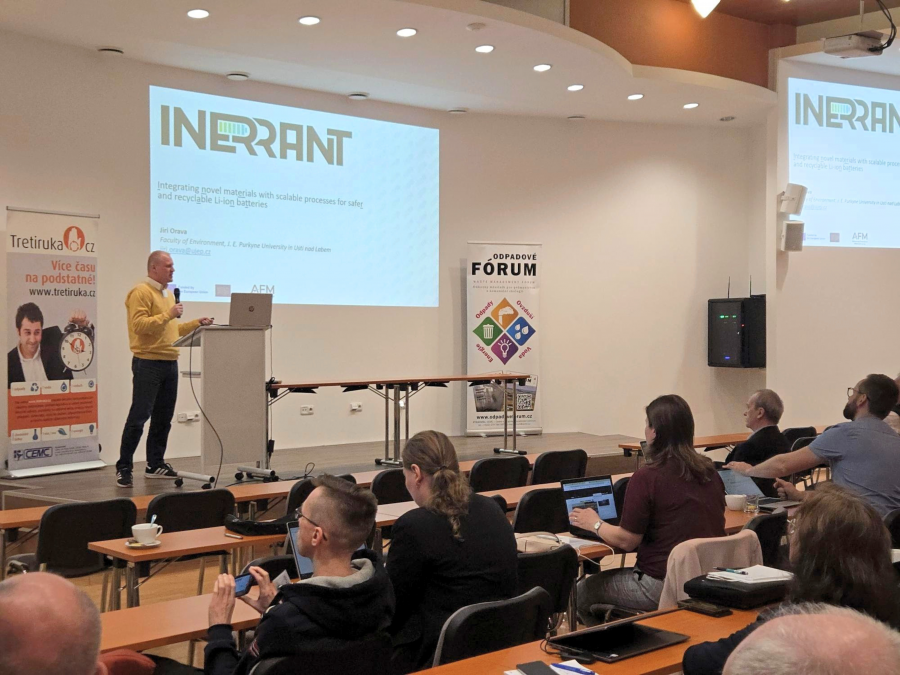
Jiri Orava (UJEP) introduced INERRANT’s mission at a major industry forum focused on waste management and recycling in the automotive sector in Czech Republic. His presentation emphasized the project’s overarching goal: integrating novel materials with scalable processes to enable safer, high-performance, and recyclable lithium-ion batteries. Furthermore, Orava detailed how the consortium pioneers a "safe-and-sustainable-by-design" strategy across all key battery elements (anodes, cathodes, separators, and electrolytes) to establish a sustainable manufacturing paradigm vital for Gigafactories. In parallel, the project is developing low-waste hydrometallurgical recycling processes aimed at meeting – and exceeding – EU 2030 recycling targets.
As electromobility accelerates, so do challenges related to sustainability and resource use. INERRANT addresses these through four key priorities: enhancing battery safety, optimising performance and fast-charging capability, enabling efficient recovery of critical raw materials, and supporting industrial transformation toward next-generation battery technologies.
The forum’s focus on recycling and production waste aligned closely with INERRANT’s vision. Engagement with industry leaders and innovators from across Central and Eastern Europe – including companies working on electric vehicle battery recycling and e-waste recovery – highlighted strong synergies and opportunities for collaboration.
Building Momentum Across Europe
These early conference participations demonstrate INERRANT’s strong commitment to connecting research with industrial application. By engaging with diverse audiences – from chemists to battery engineers and circular economy stakeholders – the project is already laying the groundwork for impactful collaboration and innovation. As INERRANT progresses, its partners will continue to share results, exchange knowledge, and contribute to shaping a more sustainable and competitive European battery ecosystem.